Chapter 1: The Apprenticeship of a Statesman, 1842-1892
Key figures
Early Life and Education
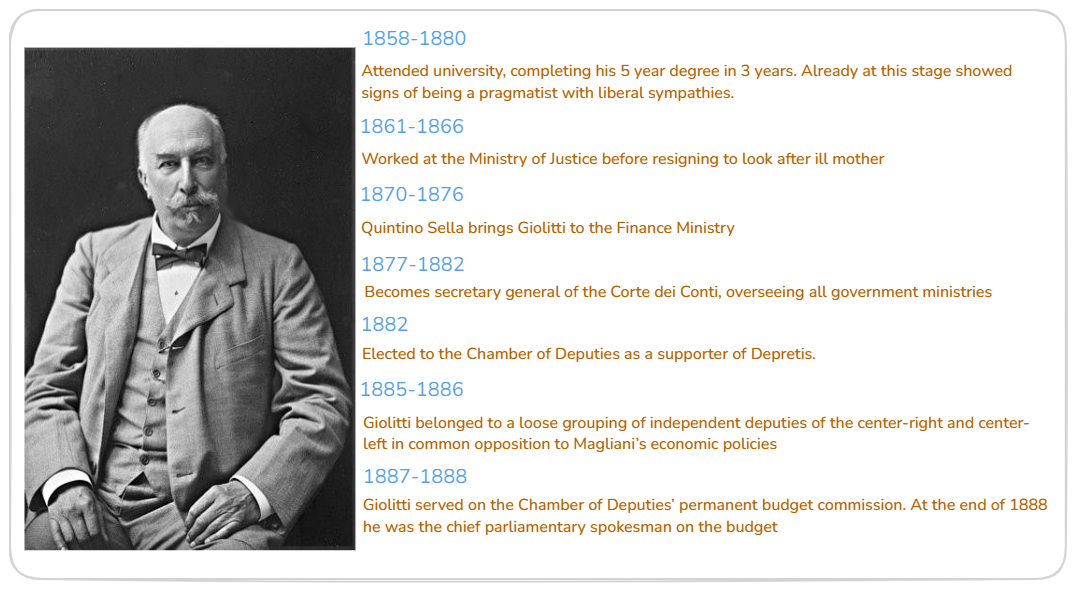
"Giolitti belonged to the second generation of Italian leaders who emerged as relatively young men on the parliamentary scene around 1880...He would be one of the first statesmen to have no ties to the wars for independence...before he entered politics, Giolitti was part of the small administrative elite that understood almost all facets of the emerging state apparatus."
"Giolitti made issues of balanced budgets and lower taxes his own...He called on the ruling elites to turn inward and to concentrate on domestic policy. This hard message grated on many in the Risorgimento generation who dreamed of a greater Italy."
"In 1858, at age sixteen, he entered the University of Turin. He was at the university during the most dramatic moments of the process of unification...this lack of military experience would be held against him as long as the generation of the Risorgimento was active."
"He has left little record of the evolution of his thought between 1860 and 1880. What we have, indicates that Giolitti already shied away from sweeping changes and great gestures. His thesis, on the social and legal position of the family, questioned the rigid application of Piedmontese law, which placed married women in a position of substantial subordination to their husbands in the establishment of the household and all legal matters. But he did not call for sweeping changes: 'Psychology, in fact, demonstrates that the faculties of women are equal to those of men and there are only differences in the manifestation of these faculties.' He made and interesting connection between despotic family relations and political repression: 'It can frankly be asserted that modern civilization derives from the proper organization of the family, as is revealed by the experience of the peoples of the East among whom the tyranny of the husbands over wives finds an echo in the despotism of the Sultans or the Shahs.' When it came to the right to vote, however, Giolitti drew back on pragmatic grounds, as he would throughout his career. He never opposed the principle of female suffrage, but argued that other legal and social changes must take place before it could be granted."
First steps in the State administration
"Giolitti soon came to the notice of Quintino Sella, who brought him to the Finance Ministry in 1870 and 1871. Sella, as one of the most assertive and dynamic politicians of the Historic Right, introduced the draconian grist tax in 1868...Giolitti remained with Sella's successor, Marco Minghetti, from 1873-1876."
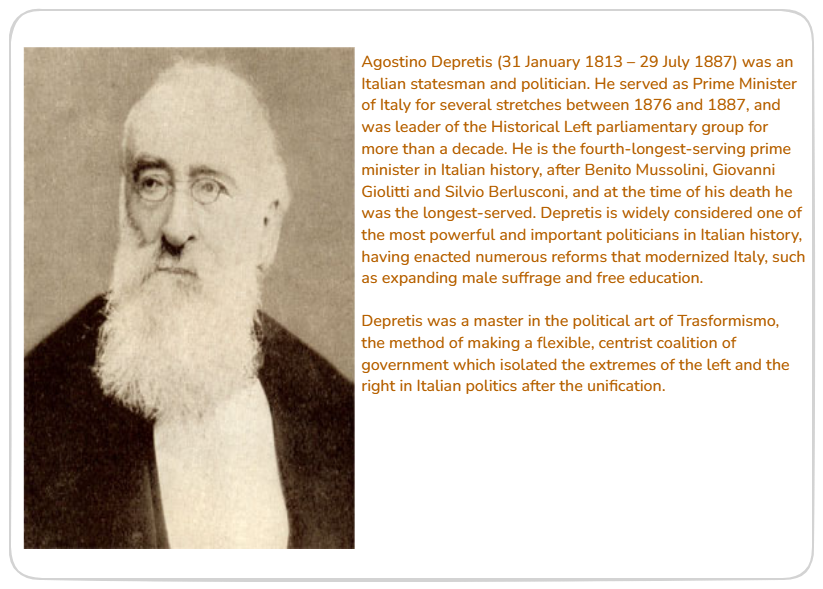
"Up to 1876 Giolitti's career had been sponsored by prominent politicians of the Historic Right, who had run Italy since unificiation; in that year, however, the leader of the left, Agostino Depretis, took office...When Depretis became finance minister in 1876, he appointed Federico Seismit-Doda, as his secretary general; Giolitti remained director general for direct taxation"
"Giolitti did not have a smooth ascent. After a battle with Seismit-Doda...in 1878, he resigned...Seismit-Doda, more a politician than a financial expert, found that Giolitti ignored his orders."
"Giolitti, only thirty-five years old, accepted a position as secretary-general of the Corte dei Conti. The Corte dei Conte, the highest state administrative oversight body, reviewed the expenditures of all government ministries...Rarely has an aspiring politician had such a comprehensive overview of the entire state administration. His 5 year stint at the Corte dei Conti was interrupted by 6 months as royal commissioner to sort out the affairs of the Opere Pie di San Paolo di Torini, which he transformed from a loosely organised rural credit institution into one of Turin's modern banks, the Istituto Bancario S. Paolo. In the process Giolitti established important contacts with the city's financial and administrative elites"
The Parliamentarian
"In calling the elections of 1882, the first under the new, expanded electoral law, Depretis sought to broaden the basis of his majority by bringing in emerging social groups, especially in the South, and to reach an accommodation with part of the Historic Right. Depretis also offered some tax relief after years of austerity. To this end, he entrusted the Finance Ministry to the Neapolitan Agostino Magliani, who ended the grist mill tax (macinato) and currency inconvertibility, the corso forzoso. But Magliani, who never saw an expenditure he did not like, had no plans to cut the budget to compensate for lost tax revenue. For example, the War Ministry budget grew from 238 million lire in 1882 to 403 million in 1888–1889, as Italy prepared for colonial expansion in Africa. Magliani attempted to cover the shortfall by encouraging foreign investment, but by the mid-1880s, agricultural crises and foreign doubts about Italian stability led to growing deficits.¹⁶
Though Giolitti ran as a supporter of Depretis, he regarded Magliani much as a teetotaler might view a habitual drunk. He made equalization of tax burdens and relief for poor and middle-class taxpayers the centerpiece of his campaign, with the clear understanding that major reductions in expenditures, especially in the military budget, would balance the lost revenue: “Italy, which remembers the enormous sacrifices made to acquire its independence, certainly will not put it at risk in order to undertake political adventures or out of a desire for military glory, which is false glory if it does not have as its aim the security and dignity of the country.” Giolitti’s program appealed to the small farmers and even to some workers who received the vote for the first time in 1882. He called for recognition of workers’ mutual aid societies and for accident, sickness, and old age insurance.¹⁷
During his first year in the Chamber of Deputies, Giolitti worked on the local level to secure his political base. He lobbied the prefect of Cuneo to have the town council of Dronero dissolved for financial mismanagement. The new elections led to the election of Giolitti’s cousin as mayor of Dronero. A year later Giolitti pressed the Ministry of Public Works for a road to be built through the Valgrana. Ignoring his caution on military expenditures, he also worked with the mayor of Cuneo to increase the number of artillery batteries in the town from one to three. By the end of 1883, Agostino Moschetto wrote to Giolitti: **“By now when the public has need of something, the following phrase comes naturally, ‘See Giolitti, he’ll take care of it.’”¹⁸
In Opposition
"Despite Depretis’s comfortable majority in the new Parliament, the prime minister faced serious problems over the future management of the railway system and measures to deal with the agricultural depression of the 1880s. In 1883, Giuseppe Zanardelli and Alfredo Baccarini, two prominent leaders of the left, resigned in protest against Depretis’s alliance with the right and center. They were soon joined by Francesco Crispi, Benedetto Cairoli, and Giovanni Nicotera (the five were collectively known as the Pentarchy), who defended the pure left tradition that Depretis allegedly abandoned. By 1885, Giolitti found himself drawn to the opposition because of Magliani’s financial policies. The finance minister had established two budgets: one, for current accounts, could be covered by tax receipts; the other, for capital expenditures, could not. Magliani argued that the latter category was of long-term value and should be treated differently, but the consequences were disastrous, especially after the government sent an expedition to the African port of Massaua in 1885. Giolitti’s Piedmont viewed the colonial adventure as wasteful and unnecessary, especially if it meant increased taxation for a rural population already under great stress.¹⁹
Depretis tried to persuade Giolitti that the opposition was too heterogeneous and politically ambiguous to become a real alternative. Giolitti acknowledged that “in the opposition we agree only to say no, not to govern the country.”²⁰ Nonetheless, he had little choice but to respond to the impact of the economic crisis on his constituency. Beginning in 1885, Giolitti became more insistent in his call for tax relief and budget reductions to cover it. On December 14, 1884, he joined protectionist Pietro Lucca and 134 other deputies in calling on the government to ease the distress of the countryside.²¹ On March 12, 1885, he moved to reduce the price of salt from 40 to 30 lire per kilogram and to cut the surtax on land with an eye to its eventual elimination. Times had changed, he noted, from the emergency years when the Historic Right was in power. Then the government had increased the price of salt and imposed the land tax, but now a continuation of such policies risked upsetting the balance of rural Italy by destroying the social order based on small proprietorship. The peasant farmer could no longer support the tax burden in an agricultural depression. The increasing number of agrarian strikes and the constant emigration from the countryside were symptoms of a breakdown of this social solidarity. The salt tax, he argued, fell especially hard on the peasants and workers. Giolitti insisted that his proposed cuts were not going to aggravate the budget deficit because reductions could be made in excess expenditures.²²"
The Railway Question
In a country still struggling to unify the national territory, the rail system took on special significance. The question of state versus private management raised issues of principle about the proper role of the government and concrete questions about how much domestic production would be required in rail construction. Management of the railway system had been put under state control during the last governments of the Historical Right in 1874. Negotiations for a new settlement with the private companies and the Rothschild bank began under Sella and continued in 1876 under the Depretis government with Giuseppe Zanardelli, a proponent of private ownership, at the Ministry of Public Works. Depretis eventually returned management of the system to private companies in the late 1870s. In 1885 another Depretis government had to renew the conventions with the railway companies. Under the plan worked out in 1885, three companies managed the system: the Società per le Strade Ferrate Meridionali ran the Adriatic lines, the Società per le Strade Ferrate del Mediterraneo held the western concessions, and the Società per le Strade Ferrate della Sicilia had the island routes.
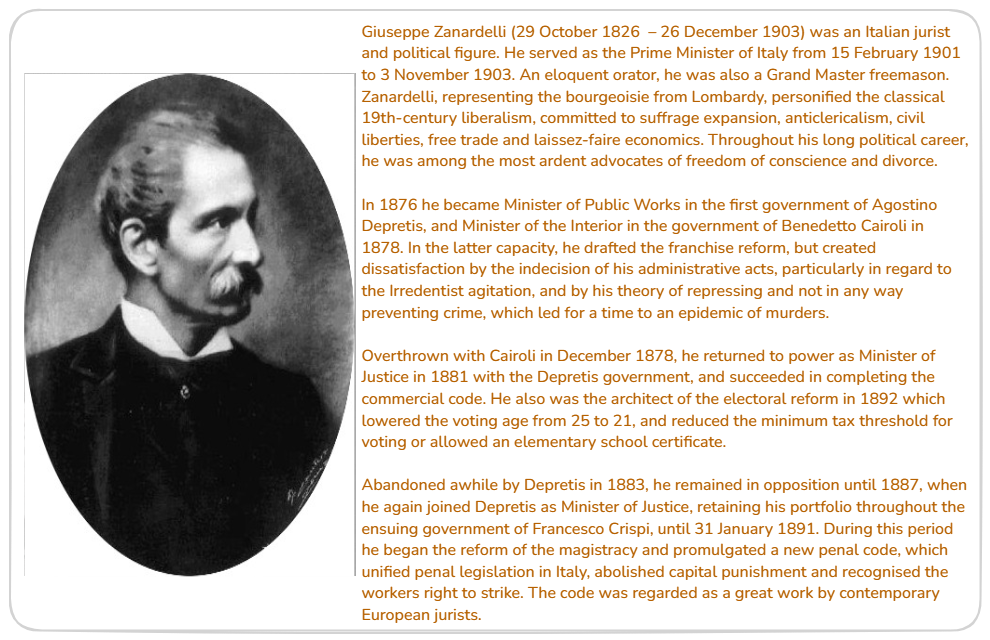
Zanardelli, Giolitti’s rival and sometime ally for the next eighteen years, personified classical nineteenth-century left liberalism’s commitment to suffrage expansion, anticlericalism, civil liberties, and laissez-faire economics. With Depretis and Cairoli he shared the experiences of the Risorgimento battles and the years of opposition to the Historical Right. Zanardelli was the architect of the electoral reform of 1882, which reduced the voting age from twenty-five to twenty-one, and lowered the minimum tax payment for voting or allowed possession of the elementary school certificate to qualify for the franchise. As a practicing lawyer, he developed a commitment to civil liberties and a suspicion of government interference in the rights of free press, association, and speech that paralleled his hostility to government economic control. Austrian rule over his native Brescia had been both politically repressive and overly regulatory in economic life. The Lombard bourgeoisie whom Zanardelli represented, viewed political and economic liberty as part of the same struggle.²⁴
Giolitti was separated from Zanardelli, who was born in 1826, by more than years, conflicting ambitions, and political experience. As a Piedmontese whose family had been in government service for generations, he was less attracted to the Risorgimento as a movement of national independence than he was to its tradition of state building. His career began under conservatives like Silvio Spaventa, who accepted a governmental role and indignantly rejected accusations of statism. But, in 1885, Giolitti sought a middle position on public versus private control. He supported both the rail legislation and the moderate protectionist provisions that had been written into the legislation to ensure contracts to domestic producers.²⁵
The Growing Rift with Depretis
In 1885–1886 Giolitti belonged to a loose grouping of independent deputies of the center-right and center-left that linked conservatives Antonio di Rudinì and Sidney Sonnino and left liberals Luigi Pelloux, Domenico Berti, Felice Chiapusso, Tommaso Villa, Bruno Chimirri, Pietro Lacava, and Luigi Roux in common opposition to Magliani’s economic policies.²⁶ Depretis tried to lure Giolitti back in early 1886 but had little success. Instead, Giolitti and fellow independent Sidney Sonnino became the opposition’s spokesmen on fiscal issues. Mercilessly, he added up the costs of spending, which transformed a surplus of 51 million lire in 1881 to a deficit of 46 million lire in 1886, a reversal of 97 million lire to Italy’s disadvantage. Giolitti labeled the Italian budget “a great fiction through which each person seeks to live at the expense of all the others.”²⁷ He recalled that he had been in the finance administration when the macinato was imposed: “Then it was a question of asking for sacrifices from the country to pay what the liberty and independence of Italy cost. Today what will we say to the country? That the new taxes are needed because we did not know how to run things.”²⁸ In the Proclamation of the Subalpine Opposition of April 1886, Giolitti argued that Magliani’s deficits were tearing at the social fabric of Italy: “We are convinced, finally, that if in Italy the social question has not arrived at the same dangerous level as in other nations, it would be a grave error to ignore the first manifestations [of social protest].”²⁹
Parliamentary elections in June 1886 gave the government a huge nominal victory. The ministerial forces numbered 292; the opposition, about 214. The largest opposition group was still headed by the Pentarchy, whose strongest personality was Crispi.³⁰ On November 7, 1886, in a speech to the voters in his home district, Giolitti staked out his place in the new left of the Liberal Party: “There are two political systems according to which a nation may model its conduct: imperial politics and democratic politics.” The former subordinated internal politics to the pursuit of expansion and “cannot be done without giving to the army and to the navy the largest part of the resources of the country … it demands therefore a strong government that has the support of a powerful aristocracy which, in its turn, cannot exist without large-scale property.” In contrast, a democratic system ensured the well-being of the greatest number of citizens by favoring education, industry, and agriculture, and by reducing public expenditures to the minimum necessary. **Giolitti sought to fuse the concern for civil liberties that had been a hallmark of the left with the rigorous financial policies of Sella.**³¹ He also revealed a more dynamic theory of state activity: “In Italy private initiative, if it can provide many services of public interest, certainly could never furnish the railway construction services and above all could not provide them in those areas where they are most urgently needed.”³²
At the beginning of 1887, Depretis’s government found itself in difficulty. The loss of 500 soldiers at Dogali in East Africa in January aroused opposition to a costly colonial policy. In February, when Depretis resigned, **Giolitti and Pietro Lacava, a veteran left liberal from Potenza, backed Crispi to succeed him, but the cagey Depretis outmaneuvered his opponents by reaching his own agreement with Crispi, who abandoned the opposition.³³ Giolitti’s position changed once the new Depretis government took office. Crispi’s participation meant that the dissidents could not attack in the same way, yet Magliani was still at the Finance Ministry. During the session of 1887–1888, Giolitti served on the Chamber of Deputies’ permanent budget commission, which made it difficult to hide his views on the budget for 1887–1888. Initially he adopted a friendly, but critical, position toward a government dominated by Crispi, whom he admired. When challenged by the conservative Ascanio Branca, who pointed out the obvious—that “the minister of finance is still the same”—Giolitti responded somewhat lamely: “Honorable Branca, I look at the government in its totality and it represents, in my eyes at least, a very different direction from the past.”³⁴ To buy time, Giolitti asked for a balanced budget by November. The conservative Ruggero Bonghi refused to let Giolitti off the hook on the question of financial rigor, but Giolitti responded, “Questions of confidence are not regulated by rules of arithmetic … I said that on balance the present ministry inspires confidence in me.” In short, the issue was no longer financial, but political.³⁵
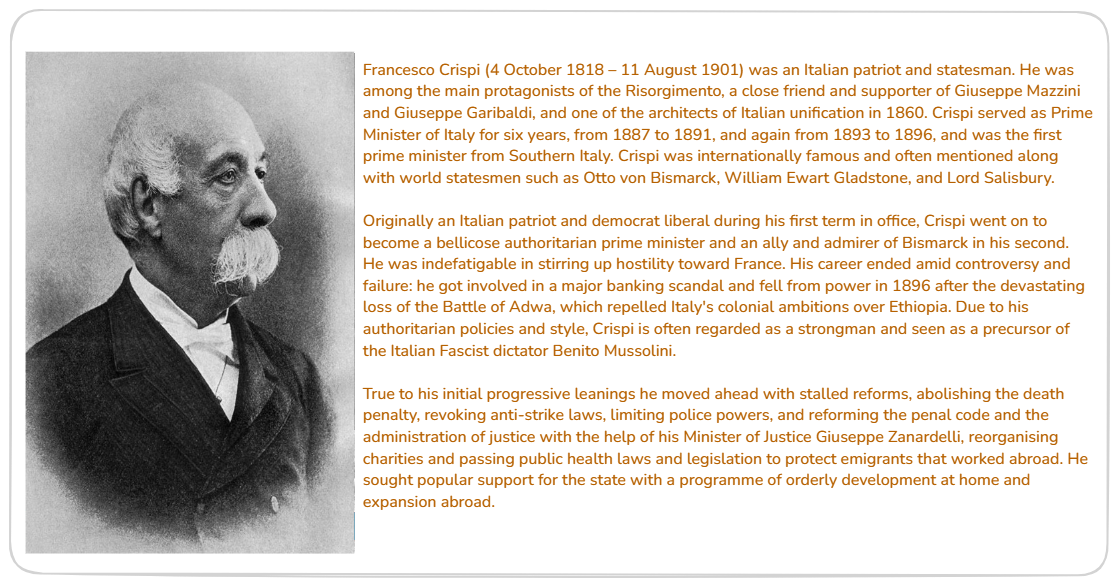
When Depretis died in late June 1887, Crispi moved up to the presidency of the Council of Ministers; Magliani remained finance minister. The Sicilian statesman came into office late in life, with enormous ambitions and great energy. Shortly before entering the government, Crispi indicated that he wanted to reshape politics by creating a true party system that would dissolve Depretis’s alliance with leaders of the Historic Right. Crispi believed that it was the role of the parties to indicate to the crown the next leader of the government, and he called for the formation of a conservative party to compete with the progressive party that he intended to create.³⁶ But the clarity that Crispi desired was an unattainable ideal for liberal Italy. Some of his support came from Giolitti and the dissidents, but that group was itself a composite of right and left.³⁷ Determined to accomplish much quickly, Crispi preferred a government clearly oriented to the left. He took not only the presidency of the council but also the posts of minister of the interior and of foreign affairs.
The Bismarckian model of a powerful chancellor-executive that Crispi had in mind was like the two-party system, a transplant that fared poorly in Italy’s political climate.
Yet the government accomplished a good deal over the next two years. Depretis and Crispi pushed through a tariff revision in 1887; the next year saw the reform of communal government; in 1889 Zanardelli’s new penal code passed, as well as a law allowing the state to take over public charities and to liquidate the formerly religious institutions. Crispi moved ahead with expansion of the army and navy and with closer ties to Germany and Austria.³⁸
Giolitti’s voting record during this period reveals a mixed progressive record. As a member of the commission that worked on the draft law on communal elections, he supported the expansion of the electorate and the election of mayors of larger cities.³⁹ But during the debate over a new public security law in November 1888, Giolitti sided with the government to keep the istituto dell’ammonizione (administrative surveillance) and to exclude those who were under ammonizione from the vote. The Socialist Andrea Costa, who had been under special surveillance, argued in vain that the administrative controls without trial should be abolished, on grounds that one should not be held for mere suspicion.⁴⁰ Giolitti’s stand on spending reductions and tax reductions gained him a position of great influence. At the end of 1888 he was the chief parliamentary spokesman on the budget and could not long delay a break with Magliani without losing credibility.⁴¹ Crispi finally replaced Magliani as finance minister with Bernardino Grimaldi, a veteran of the parliamentary left. Costantino Perazzi, a former colleague of Sella and longtime politician of the Historic Right, became minister of the treasury. Sidney Sonnino entered the government for the first time as Perazzi’s undersecretary.** (The appointments of Perazzi and Sonnino presumably ended Crispi’s desire for a coherent two-party system.) Grimaldi proposed dealing with the deficit while providing revenue for Crispi’s ambitious foreign policy by increasing taxes, but Giolitti would accept no general tax increase except as an emergency measure, virtually to save the independence of the country. He confidently insisted on spending reductions and improved administrative procedures: “I have seen in all administration that those who know how [to administer] obtain great results with few resources and those who do not, need much to accomplish little.”⁴² To placate Crispi, Giolitti excluded foreign policy from the budget cuts, but a line had to be drawn in Africa, because if Italy continued “to spend as much as we are spending today in Africa, a violent reaction will not be long in coming which might possibly induce the Parliament to call for the final withdrawal of our troops.”⁴³
Military expenditures accounted for much of the deficit, but mere economies would not solve the problem. In 1884–1885 the government budgeted 310 million lire for the Ministries of War and the Navy, 17 percent of total state expenditures; by 1889–1890 the military outlays had risen to 457 million lire, 24.3 percent of total state expenditures.⁴⁴ Despite his criticism of Crispi’s African policy, Giolitti avoided backing the prime minister into a corner by offering to delay a final vote until Grimaldi could reconsider the budget, but at this point, both Grimaldi and Perazzi chose to resign rather than face defeat on the tax proposals. After little more than six years in the Chamber of Deputies, Giolitti replaced Perazzi, thereby leapfrogging his future rival Sonnino, who left the government.
Crispi, Giolitti, and the Banks
The economic issues that brought down Magliani and Grimaldi did not go away.⁴⁵ Sooner or later Giolitti’s austerity program would conflict with Crispi’s foreign and military policies in Africa. The government had few options. Pension funds were drastically underfinanced, and the state had issued an excess of railroad bonds. Responding to an inquiry by Magliani in the Senate, Giolitti admitted that the budget could not be balanced rapidly; tax receipts were lower than expected and the government had overextended itself. Nevertheless, Giolitti promised to reduce the deficit to 48 million lire in 1889–1890 and stated that it would be even lower if the underfunded pension accounts were left out.⁴⁶
As minister of the treasury, Giolitti offered a preview of his strategy toward the nascent labor movement when he supported legislation to allow worker cooperatives to compete for state contracts. The Socialist Andrea Costa responded that if Giolitti continued on this road, “We will be here to support him with all our heart, because we accept good from wherever it comes.”⁴⁷ A year later, under questioning from the Socialist Enrico Ferri about the failure to apply the new rules, Giolitti asked for more time to fine-tune the procedures but insisted that cooperation between the labor movement and the state would bring substantial benefits for the working classes.⁴⁸ Giolitti’s tenure as minister of the treasury also coincided with a deepening economic crisis that revealed fundamental weaknesses in the banking system of the new state. Two parliamentary questions directed at Giolitti by Luigi Diligenti of Arezzo and by Domenico Zeppa of Rome in March 1889 were the opening salvos of a scandal that almost destroyed Giolitti’s career in 1893. Both questions involved the excessive and uncontrolled issuance of paper money by the banks. Giolitti answered that he had been in office for only a short time, and that Minister of Agriculture, Commerce, and Industry Luigi Miceli, who shared jurisdiction over the banking system, would soon present a reform bill.⁴⁹ In June, Maggiorino Ferraris, a deputy and political commentator for the influential Nuova antologia, and Diligenti again charged that the money supply was out of control and cited the Banca Romana as an institution engaging in questionable practices. Giolitti then made a remark that would come back to haunt him in 1893. He could not, he argued, discuss the Banca Romana because “There is in process, by order of my colleague, the minister of agriculture, an accounting of all the issuing institutions. The Chamber can be certain that, if as a result of this accounting, some irregularity emerges, whatever the institution in question, the irregularity will be taken care of.”⁵⁰
Giolitti plunged into a swamp from which it would take years to extricate himself. The banking system was beset by problems. In 1889 a small institution, the Banca Adriatica, collapsed when the speculative bubble in building and land ventures burst. The Adriatica was tied to the Banca Tiburtina in Rome, itself endangered by the collapse of the building boom and bailed out by the Crispi government. The Banca Tiburtina in turn was connected to the Turinese Banca di Sconto e Sete, whose collapse would have threatened investments of the royal family. In 1889 Giolitti arranged for the Banca Nazionale to rescue the Banca Tiburtina and a development company, the Società Esquilino, but these stopgap measures only increased the bad investments of the more solid banks and pressured the weaker issuing banks to solve their problems by exceeding the legal currency limits. The Tiburtina bailout brought one side benefit to Giolitti; it **marked the beginning of the political alliance with Urbano Rattazzi, who was responsible for the royal investments and was one of the king’s closest advisers.
The Banca Romana was an exceptionally weak point in a rickety banking structure. Its position was unusual because it had the power to issue paper money (along with the Banco di Napoli, the Banco di Sicilia, the Banca Nazionale, the Banca Toscana, and the Banca Toscana di Credito). These issue banks had their origins in the pre-Risorgimento states of the Italian peninsula. The Banca Nazionale, as the major institution of the Piedmontese kingdom, would have been the most likely central banking institution, but regional politics dictated that the most likely central banking institution, a Roman institution also be allowed two Tuscan banks, two southern banks, and a Roman institution as the Banca dello Stato Pontificio and was reorganized under its new name on December 2, 1870. Under its director, Bernardo Tanlongo, the Banca Romana began to make loans to various politicians and governments.
The Minghetti-Finali banking law of April 30, 1874, set limits on how much money the six issue banks could print, but failed to create effective supervision over the total money supply. Banks were obligated to accept each other’s paper and were expected to settle balances every ten days. However, the Banca Romana’s consistent indebtedness to the other issuing banks indicated that it had been exceeding the legal limits on issuing banknotes.⁵²
Italy’s need to borrow on foreign exchange to finance its deficit made the situation even more precarious. The stability of Italian bonds on the Paris market depended on the solidity of the banks, but with the banks engaged in speculative real estate ventures and heavily involved with building firms, the failure of any one of these enterprises could set off a chain reaction that would bring down smaller banks like the Banca Tiburtina, the Banca di Torino, and the Banca di Sconto e Sete. The minister of agriculture, industry, and commerce (AIC) shared responsibility for the banks with the minister of the treasury. In the Crispi government, veteran left liberal Luigi Miceli held the AIC post. At the request of Giovanni Nicotera, who disliked the administrators of the Banco di Napoli, Crispi asked Miceli to undertake an inspection of the bank. Miceli put the inquiry under the direction of a conservative senator from the Veneto, Giacomo Giuseppe Alvisi, who had a long-standing interest in banking issues. Giolitti, the new minister in the government, designated one of his aides, Gustavo Biagini, to assist Alvisi, but understood that this can of worms should be left, if possible, to Miceli and Crispi. Giolitti did not know (or perhaps did not want to know) that in April, following complaints by the Banco di Napoli’s director, Girolamo Giusso, Miceli pressured Alvisi to leave that bank alone. When Alvisi turned his attention to the Banca Romana, Miceli offered the help of Antonio Monzilli, for this time Alvisi distrusted Miceli and, by extension, Miceli’s agent Monzilli, and depended on Giolitti’s man Biagini to conduct the investigation of the bank.⁵³
In fact, the whole investigation was conducted under a cloud of mistrust. Banca Romana director Tanlongo tried to bribe Biagini, who told Alvisi. As a result, Biagini inspected the Banca Romana, Monzilli spied on Biagini, and Miceli worked to keep the lid on the affair. The Alvisi-Biagini report was not due until autumn, but Alvisi must have informed Miceli of a potential scandal because Miceli wrote to him in July: "You, a man of impeccable honesty and my old friend, cannot truly say that you intend to publish your report on the Banca Romana, because the consequences of this publication would fall on me, who charged you with the task of investigating."⁵⁴ The Alvisi-Biagini report found a complete failure of accounting practices and excessive printing of banknotes amounting to 25 million lire. Miceli, however, instructed Biagini not to breathe a word of the report, even to Giolitti and his superiors at the Treasury Ministry. Miceli presented a general summary to the Council of Ministers at the end of the year. Both Crispi and Giolitti later said that they did not press their colleague, but Crispi recalled that Giolitti also stated that the report contained “stuff for the Penal Code [roba da Codice Penale].”⁵⁵ At this point, the problems of the Banca Romana still mainly involved illegalities within the bank and not the political world. However, whether as a result of the investigation or out of caution, Tanlongo began to extend his reach into politics.⁵⁶
The Break with Crispi
By the end of 1889, Giolitti’s relationship with Crispi was under increasing strain. Giolitti threatened resignation if the navy minister did not bring his budget within limits indicated by former Treasury Minister Perazzi.⁵⁷ Crispi responded that Giolitti should present his budget and that any extra funds for the military would come in a special bill later in the year. The prime minister somehow got the impression that Giolitti agreed to this procedure. Instead, Giolitti insisted that he would support indispensable military expenditures only when they were covered by revenue.⁵⁸ Giolitti’s December financial report to Parliament made it clear that the true deficit was much larger than anticipated and that economies would reduce it to manageable size by 1890–1891—only if military costs could be controlled. Just at the end of the speech, almost in passing, Giolitti mentioned among the measures for future action a proposal for the reorganization of the banks of issue so that they “might escape from a precarious situation.”⁵⁹
The opposition in Parliament sniffed blood. In early 1890 several deputies pressed for more exact budget figures. The treasury minister glumly admitted that he could not support major tax increases but that “major economies, under present conditions, are not possible to make.”⁶⁰ The banking situation was another exposed flank. In March, Giolitti had authorized the Banca Nazionale to bail out the Banca di Torino and the Banca Subalpina, two Piedmontese banks that were deeply involved in building speculation, by permitting the Banca Nazionale to issue notes for 50 million lire without gold backing. When Giolitti went to Parliament for permission to legalize this excess issue, his two most persistent critics, Diligenti and Maggiorino Ferraris, narrowed in on the state of the banks.⁶¹ Giolitti touched on the banks before the Senate on March 25, 1890, when he assured the Senate that despite some irregularities, “nothing had been found that might compromise in the minimal way the solidity of any [banks].”⁶² Given Giolitti’s later explanations that he had not seen the full Alvisi-Biagini report and had not been informed by Biagini of the true situation at the Banca Romana, this was a risky statement.
Giolitti had taken on greater responsibility for the economic policies of the Crispi government on becoming finance minister after the resignation of Seismit-Doda on September 14, 1890. But conflicts with the prime minister also continued. Giolitti and Crispi disagreed over to what degree financial considerations should restrain the actions of the government. Giolitti tended to subordinate everything to the achievement of a balanced budget. Crispi clearly did not feel thus constrained, especially in foreign and colonial policy.⁶³ At the meeting of the Council of Ministers on September 22, 1890, Giolitti insisted that the public works budget be held at current levels and that of the army and navy reduced. He won this battle despite protests from the ministers of public works and the navy.⁶⁴ On November 23 and 30, 1890, Crispi called elections that resulted in a substantial victory for the government in all parts of the country. In the North the supporters of the ministry won 167 of 222 seats; in the center, 71 of 83; in the South, 115 of 144; and on the islands, 53 of 59.⁶⁵
As often happened, large majorities proved deceptive and did nothing to heal the split within the government. Giolitti and Minister of Public Works Gaspare Finali had been at odds over Finali’s refusal to accept the limits on spending demanded earlier by Giolitti. Finali offered to resign on November 18, just before the elections. On December 8, Giolitti refused to present the budget if the public works budget exceeded the agreed-on figure. He, too, offered his resignation. An exasperated Crispi informed Giolitti that Finali had already resigned and then asked Giolitti, as the only one who knew the budget well enough to present it to Parliament, to become minister of public works ad interim.⁶⁶ When Giolitti refused, Crispi expressed some bafflement: “Finali having resigned, you should stay at your post and not put me in the position of finding myself on the eve of the parliamentary session having to fill two cabinet positions.”⁶⁷ The prime minister suspected the king’s close adviser, Urbano Rattazzi, of having engineered the resignation. Giolitti had maintained his credibility on the budget at Crispi’s expense. The two very different political personalities, who represented the past and the future of the liberal left, now went their separate ways.⁶⁸
Aided by an incongruous alliance with the conservative Antonio di Rudinì, Crispi’s government limped into 1891, but fell on January 31. With Crispi on the sidelines, Roux and other friends of Giolitti wanted to forge an alternative government that would reach from the conservative Di Rudinì to Giolitti and Zanardelli on a program of a balanced budget, limited commitments in Africa, and calmer relations with France in the context of the Triple Alliance.⁶⁹ The lines that separated Sonnino or Rudinì from Giolitti had not hardened into an extremely ambiguous position on the right, as he would throughout his career. In 1889–1890 only a few deputies on the right—Ruggero Bonghi; the Piedmontese Giuseppe Colombo; another Lombard moderate, Pietro Carmine; the Milanese industrialist Giuseppe Colombo; another Lombard moderate, Pietro Carmine; the Milanese ally of Rudinì, Giulio Rubini—called for intransigent conservative opposition. Equally prominent conservatives, like Rudinì and Luigi Luzzatti, were perfectly willing to ally with left liberals, and among the hardliners of 1891, Prinetti and Tittoni would later serve in governments dominated by Giolitti. The fundamental issue of the day was financial austerity. Limits on taxation implied caution in colonial and foreign policy. On these issues part of the right and left of the Liberal Party could agree. **Labor unrest and the rise of socialism had not yet become so acute as to create new divisions over how to defend the social order.**⁷⁰
The problem was to bring Rudinì, Zanardelli, and Giolitti together, but the fusion of left and right foundered on the conflicting ambitions of the major participants. Giolitti wanted the interior ministry and refused to form a government with the conservative Rudinì without the cover of fellow left liberal Zanardelli, who preferred a pure left solution.⁷¹ In the end Rudinì succeeded in forming the new government, a typical product of the compromises that dominated in the Italian Chamber of Deputies. He negotiated on his right and on his left to create his own version of trasformismo. The interior ministry went to a prominent left liberal and former member of the Pentarchy, Giovanni Nicotera, who had been the scourge of Southern deputies of the Historic Right in the same position under Depretis. With Nicotera and War Minister Luigi Pelloux, Rudinì added two political figures who were associated with the left, but Nicotera cost him Giolitti’s backing. As a counterbalance, two leaders of the right, Treasury Minister Luigi Luzzatti and Finance Minister Giuseppe Colombo, came on board. Luzzatti’s political career dated back to 1868 and 1869, when he served as economic counselor and secretary-general to Marco Minghetti in the Menebrea government. His passion for reform led him to accept a substantial role for government in the economic life of Italy. The pragmatic Giuseppe Colombo, former head of the Politecnico of Milan and a founder of the Italian electrical industry, called for moderate tariff protection for industries that he felt would eventually grow on their own; he was rigidly associated with holding the line on government expenditures.⁷²
The Rudini government: Banking and Labour problems
Two problems that emerged during Rudinì’s administration dominated politics for the next several years: the banking scandal and worker unrest. They replaced the deficit that had been Giolitti’s stalking-horse. The right of the six issue banks to print banknotes was up for renewal in 1891. The debate over plurality of issue banks or a single central bank involved strong regional interests. Crispi had favored a single bank but did nothing about it. Rudinì and Luzzatti supported the old system of six issue banks. Finance Minister Colombo backed a single bank but did not press the matter.⁷³ To buy time, AIC Minister Bruno Chimirri and Treasury Minister Luzzatti proposed to extend the status quo until the government formulated a solution. In a measure designed to aid the Banca Romana, Luzzatti’s legislation also ended the obligation of the issuing banks to redeem their notes held by other banks (the riscontrata).
The real action on the banking front took place in the Senate, where Alvisi decided to make public his findings of discrepancies between the official and real levels of currency circulation. As Alvisi started to speak, Luzzatti intervened and Senate President Domenico Farini warned Alvisi that he might endanger the interests of the country. Before being cut off, Alvisi managed to put on record that although the official issue of currency was 53 million lire, he had found 128 million. When he began to quote from Biagini’s report, Farini and Luzzatti stopped him. Nonetheless, Alvisi left no doubt that a serious problem existed.⁷⁵
The second issue, worker unrest, allowed Giolitti to establish his progressive credentials. Concern over the nascent labor movement grew after the disorders and strong government reaction on May 1, 1891. May Day had been proclaimed a holiday by the workers, an action viewed by bourgeois opinion throughout Europe as a deliberate provocation. In anticipation of trouble, Nicotera issued a circular to the prefects on March 18, 1891, authorizing them to suppress any meeting, public or private, that might disturb public order, except when the meeting was strictly limited to specific guests and entry could be controlled. Immediately after May 1, Nicotera requested further legislation to ban meetings, worker organizations, and parties. He made no distinction between socialist and anarchist protests or between economic and political agitation.⁷⁶
Giolitti took a far more permissive attitude. First, he rejected Nicotera’s confusion of anarchism and socialism. Toward the anarchists Giolitti showed as little tolerance as Nicotera, but his position on the Socialists was quite different. A labor movement, he believed, was the price all modern industrial societies had to pay in the name of progress. Not that Giolitti ever favored any variety of socialism, but he accepted nonideological, economically oriented trade unions when most other liberal politicians did not. Referring to the May Day demonstrations in Europe, he asserted unequivocally: “I have never heard anyone who has dealt with economic and political questions suppose that such manifestation of the working class was an anarchist demonstration.”⁷⁷
Crispi’s many enemies had every interest in sustaining Rudinì’s government. The most effective means to bolster the government was to bring in Giolitti. Urbano Rattazzi, Giolitti’s advocate at court, won royal support for a Rudinì-Giolitti meeting, but Giolitti’s price was the exclusion of the corrupt Nicotera.⁷⁸ As it turned out, Rudinì refused to dump the controversial interior minister, and Giolitti could not afford to make a deal involving Nicotera. King Umberto agreed that Giolitti could not enter the government with Nicotera, but noted that “Giolitti is young and with time he will also be president of the Council.”⁷⁹ Sensing the direction of events, Giolitti told Farini, a confidant of the monarch, that he would not carry his passion for budget cutting to the point of harming the military. Farini’s comment was telling: “This for me is the key to the discussion of the king with me.”⁸⁰
To make matters worse for the government, Treasury Minister Luzzatti and Finance Minister Colombo disagreed on the budget. Luzzatti had been somewhat optimistic in his forecast, and a deficit loomed that he hoped to offset by new taxes. Colombo rejected Luzzatti’s proposal and resigned, taking with him the deputies of the Lombard right. The prime minister was caught, as Crispi had been earlier, between a finance minister who wanted severe limits on spending and other ministers, chiefly War Minister Pelloux, who wanted to protect their budgets. After failing to bring Giolitti on board as Colombo’s replacement, Rudinì reshaped his government by giving Luzzatti the finance ministry ad interim. On May 4 the government presented its tax proposals to Parliament, but time had run out. Sonnino and his friends coordinated their attack with Giolitti in presenting a motion of no confidence.⁸¹ In a speech that sounded almost like a program for a new government, Giolitti rejected the tax proposal as insufficient and announced that his friends would vote against the cabinet.⁸² Giolitti’s stand against taxes and for budget cuts represented the mood of the Chamber of Deputies and put him, at the relatively young age of fifty, on the threshold of power.
Summary
Early Life and Education
- Born 1842 (second generation of Italian leaders, no direct ties to the Risorgimento wars).
- 1858 (age 16): Entered the University of Turin during the height of Italian unification.
- Wrote a university thesis on the social and legal position of the family, advocating moderate reform rather than radical change. He supported equality in principle but was cautious on female suffrage, arguing that broader legal and social changes must precede it.
- Developed a preference for pragmatic, incremental solutions and domestic stability over grand gestures or military glory.
Core Beliefs Formed Early:
- Strong emphasis on balanced budgets, lower taxes, and focusing on domestic policy rather than colonial or military adventures.
- Skeptical of sweeping ideological changes.
First Steps in State Administration (1870–1882)
- 1870–1871: Brought into the Finance Ministry by Quintino Sella (Historic Right).
- 1873–1876: Continued under Marco Minghetti.
- 1876: After the Left came to power under Depretis, Giolitti remained as Director General for Direct Taxation.
- 1878: Resigned after clashing with Finance Minister Seismit-Doda (he was only 35).
- 1878–1883 (approx. 5 years): Served as Secretary-General of the Corte dei Conti (highest state audit body), gaining an unparalleled overview of the entire Italian state administration.
- Interrupted briefly to reorganize the Opere Pie di San Paolo di Torino into the modern Istituto Bancario S. Paolo, building key contacts in Turin’s financial elite.
This period established Giolitti as a highly competent technocrat with deep knowledge of public finance and administration.
Entry into Parliament (1882)
- 1882: Elected to the Chamber of Deputies under the new expanded electoral law (first elections with broader suffrage).
- Ran as a supporter of Depretis but was sharply critical of Finance Minister Agostino Magliani’s fiscal irresponsibility (large deficits, growing military spending, end of the grist tax without corresponding cuts).
- Campaign focused on:
- Equalization of tax burdens
- Relief for small farmers and middle class
- Major reductions in expenditure, especially military
- Support for workers’ mutual aid societies and social insurance
Quickly built a strong local base in Dronero and Cuneo through practical interventions (roads, local governance reform).
In Opposition and the Growing Rift with Depretis (1885–1886)
- 1885: Increasingly aligned with opposition due to Magliani’s reckless spending and the growing budget deficit.
- Joined a loose centrist grouping opposing Magliani’s policies alongside Rudinì, Sonnino, and various left liberals.
- Became one of the leading spokesmen on fiscal issues with Sidney Sonnino.
- Strongly criticized the transformation of a surplus (1881) into a large deficit (1886).
- Advocated tax relief combined with strict spending cuts, warning that excessive taxation threatened rural social stability.
The Railway Question (1874–1885)
- 1874: Railways placed under state control by the Historic Right.
- Late 1870s: Returned to private management under Depretis.
- 1885: Renewal of railway conventions with three major private companies.
- Giolitti took a moderate middle position on public vs. private control, supporting the 1885 compromise while favoring some protection for domestic industry.
Contrast with Zanardelli:
- Zanardelli represented classical laissez-faire left liberalism (suffrage, civil liberties, anticlericalism).
- Giolitti, shaped by Piedmontese state-building tradition, was more pragmatic about the role of the state.
Break with Depretis / Rise under Crispi (1886–1889)
- 1886–1887: Part of independent opposition bloc.
- November 1886: Delivered key speech outlining his vision of “democratic politics” vs. “imperial politics” — prioritizing education, industry, agriculture, and minimal public expenditure.
- 1887: After Depretis’s death, Crispi became Prime Minister.
- Giolitti served on the permanent budget commission and maintained a critical but initially cooperative stance.
- 1888–1889: Appointed Minister of the Treasury under Crispi (replacing Perazzi, leapfrogging Sonnino).
Crispi, Giolitti, and the Banking Crisis (1889–1890)
- Giolitti’s tenure as Treasury Minister coincided with a deepening economic and banking crisis.
- Faced growing problems with excessive issuance of paper money by issue banks, especially the scandal-plagued Banca Romana.
- Supported limited state intervention (e.g., worker cooperatives competing for contracts).
- Attempted to maintain fiscal discipline while navigating banking instability and colonial spending pressures.
- Authorized bailouts for troubled Piedmontese banks (Banca di Torino, Banca Subalpina) in 1890.
The Break with Crispi and Fall of the Government (1889–1891)
- End of 1889: Growing tension with Crispi over budget discipline vs. military/colonial ambitions.
- Giolitti insisted military spending must be covered by revenue; Crispi favored expansion.
- September 1890: Giolitti won a battle to cap public works and reduce army/navy budgets.
- January 31, 1891: Crispi’s government fell.
- Giolitti positioned himself as a leader of fiscal responsibility and moderate progressivism.
The Rudinì Government: Banking and Labor Problems (1891)
- 1891: Rudinì formed a new government with a mix of right and left figures (including Nicotera as Interior Minister).
- Two dominant issues:
- Banking scandal — renewal of banknote issuance rights; Alvisi exposed massive discrepancies in currency circulation (official 53M vs. actual 128M lire).
- Worker unrest — May Day 1891 disorders led to repressive measures by Nicotera.
- Giolitti took a more permissive stance toward non-violent labor movements, distinguishing between socialism and anarchism.
- Refused to join Rudinì’s government unless Nicotera was removed.
- May 1891: Coordinated with Sonnino to bring down Rudinì’s government with a motion of no confidence.
Overall Portrait: By age 50 (1892), Giolitti had established himself as a master of public finance and administration, a pragmatic fiscal conservative with moderate progressive instincts, and a skilled parliamentary tactician — poised to become one of Italy’s dominant political figures.
Chapter 2: A Disastrous Beginning: The Presidency of the Council of Ministers, 1892-1893